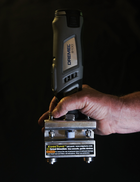
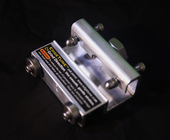
- How accurate is EdgeTune™ Pro II?
Very accurate, assuming you start with a flat base and follow the instructions.
The ceramic grinding top surface will dress perfectly square to the grind axis
when holding the dressing stone flat across the entire top surface, leaving no
center point. The fixed 1°, 2°, or 3° bearing locations are accurate within
.005 inch, providing the most accurate and repeatable settings possible. Note
there are no plastic setting dials that will wear over time.
- Will the grinding stone damage or remove too much edge material?
No. The EdgeTune™ Pro II bracket precise adjustment screws
that guard against uneven or excessive edge grinds... all that is
required are smooth, gentle strokes of the tool along the edge
(ie, simply let the tool do the work). The ceramic stone is a
very fine #600 grit (like fine emery cloth) and removes only a
few thousandths of an inch per pass... significantly less
material removal than a sharp hand file. The ceramic stone also
has extremely low heat generation, preventing any edge steel
material tempering. Edge durability is enhanced through slight
work hardening, which is true of all grinders.
- How long do the ceramic stones last?
The new EdgeTune™ Pro II design provides extremely long
stone life. Back shop users report over 200 pairs of skis/boards tuned with
just 1 stone!
- How does EdgeTune™ Pro II compare with Verdonak Racing's
SnowGlide and Wintersteiger's DiscMan?
All 3
provide an excellent, smooth sharp edge superior to hand filing.
EdgeTune™ Pro II has a finer grit, which provides less striations (smoother
surface finish) with less material removal and less heat. This saves the edge
material, and is ideal for re-sharpening the edge without changing bevel angels
significantly.
Direct comparison to the Wintersteiger Discman:
- Both use ceramic technology, and both grind @ 5700 SFM (surface feet/min).
- EdgeTune Pro II is ½ the weight of the Discman, is well balanced and fits the hand nicely.
- EdgeTune Pro II uses fixed location ball bearings for the most accurate bevel angle settings.
- EdgeTune Pro II utilizes the proven Dremel motors in both corded and cordless models.
- EdgeTune Pro II replacement stones cost $10 that will easily cover an entire season or more.
- EdgeTune Pro II costs a fraction of of Discman, offering greater value plus Dremel versatility.
- What rotary tools are compatible with EdgeTune™ Pro II?
All rotary tools that have a threaded nose cap for accessory
mounts will fit. We recommend the Dremel corded #3000 or
the cordless #8200.
Non-Dremel models will also fit, although stone height
adjustment may vary slightly
Note: worn bearings and cheaper
rotary tools may have excessive vibration, which can create a poor edge
finish.
- Does Edgetune Pro II also grind the base edge?
No. All edge sharpening should be done from the side edge. Grinding the base
edge without also grinding the base itself will leave the base edge surface
lower ("snow high") which will reduce edge contact and control. EdgeTune Pro II
kits include a DMT #600 fine diamond stone that works perfectly for
de-burring and touching up the base edge surface.
- Where do I go if I have a problem?
If the problem is with the rotary tool, follow the instructions
that came with the tool. For all other problems, please e-mail
us at service@edgetune.com